|
Just
about everybody has a water heater or is served by
one. But how much do you know about yours? We'd guess
that people could tell more things about their cars
than their water heaters, even though a car is vastly
more complicated.
When a water heater breaks, most of us are in a hurry
to get a replacement. Nobody likes cold showers.
Under
those conditions, it's hard to buy wisely. So we thought
we'd teach you a little about water heaters, tell
you why we think the Richmond water heaters that Sutherlands
sells are superior, and explain what your options
are and how they might affect you.
|
What
is a water heater?
When
you look at one, you're not really seeing the water
heater, only the sheetmetal shell. That's something
worth remembering because the shell can look fine
when the tank inside it is about to break.
Inside
that is insulation. Inside the insulation is a steel
tank with vitreous glass bonded to the inside to mostly
prevent the tank from rusting. A gas burner at the
base heats water and a flue takes the exhaust to a
vent and out. Or electric elements heat the water.
In both cases, the bottom of the tank is domed.
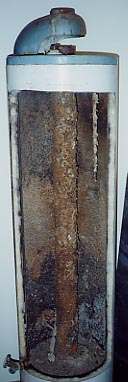
On
the Day & Night at right, taken out of an apartment
after 40 years of service, you can see the interior
of the tank and the gas flue running up the middle.
This is the same construction used today for gas heaters.
An electric tank would be the same except that there
would be no flue running down the middle, but rather,
one or two electric elements jutting out from the
side.
But
in all instances, there will be one or two sacrificial
anode rods screwed into the top and a plastic tube,
called a dip tube, running down from the cold port.
You can see the remains of the anode on the right,
hanging like a stalactite.
Gallonage,
Btu and what do I need, anyway?
This
is a place where buying more than you need is going
to cost you money, both up front in price and in the
long run in higher energy bills, while buying less
is mostly going to result in frustration. The first
question is, what size heater do you already have
and are you happy with it? |
|
 |
| If
not, there are factors you can use to compare one
tank to another. Pay attention to gallonage, Btu input
and first-hour recovery figures. Many people think,
more gallons, more capacity, but Btu input is important,
too. Some commercial water heaters have little capacity,
loads of Btu. Ultimately though, figuring out need
is as much art as science. Variables can range from
whether you have low-flow showerheads to how long
your teen-age daughter spends in the shower.
|
R-value
(insulation)
If
you go for the cheapest water heater you can get,
odds are it will have an R-6 insulation rating. That's
about minimum. If you paid a bit more, though, you
could have up to R-20. That's an investment you'd
get back many times over during the life of the heater.
|

|
|
Standby
heat losses
All
water heaters, including tankless ones, have some
standby heat losses. Tank heaters lose heat through
the walls of the tank and up the flue. Getting maximum
insulation will cut those losses considerably.
Tankless
gas ones often lose heat from the pilot light, while
electrics lose it by being plugged in all the time.
Serious
losses for all types of heaters, unless they are right
next to the outlet being used, is, from the piping.
That runs from the heater to the faucets. It's made
of copper, mostly, sometimes steel. It radiates heat
very well. |
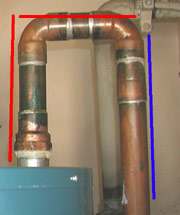
| So
if you want to cut standby losses, insulate the pipes,
if you can, and when you install a tank heater, make
heat traps out of copper flex lines. How? Use a longer
flex than you need and make a big gooseneck in it,
like a question mark. Heat will rise up the flex to
the top of the gooseneck and no farther. The photo
above left is of a commercial water heater, but the
principle is the same. Heat will rise as far as the
red lines, but not go into the blue because heat only
rises. So insulating to a little beyond the top of
the rise will be effective.
|
Anodes,
glass lining and longevity
Why
do water heaters break? Does anybody know? We'll let
you into the secret. While a glass lining mostly protects
the tank from rusting, due to limitations in the manufacturing
process there is always some exposed steel. Also,
some glass linings are more complete than others.
So exposed steel is protected from rusting by the
use of sacrificial anode rods. The principle by which
they work was discovered 200 years ago by Sir Humphrey
Davies, an Englishman.
When
the tank is filled with water, a slow electrolytic
reaction takes place whereby the anode corrodes and
the steel is protected. When no anode remains, the
steel rusts and the tank fails. If you soften your
water, beware. That can increase the conductivity
of the water and speed up the anode consumption.
How
fast a given tank lasts is a function of use, water
temperature, the quality of its glass lining and water
quality -- and how many anodes it has.
Sutherlands
sells water heaters in warranties of six, nine and
12 years. Longer-warranty water heaters generally
have an additional anode rod in the hot port. It's
also possible to buy a second anode made to screw
into the port from www.waterheaterrescue.com
and add it to a six-year-warranty tank. That will
undoubtedly lengthen the life of the tank, but the
warranty will still be six years. Whichever way you
prefer to do it, having a tank with two anodes is
another bargain like insulation, where spending a
little extra money now will pay off in the long run.
A 12-year-warranty water heater doesn't cost twice
as much as a six-year-warranty one, and if a plumber
is doing the installation, it's a small addition to
the overall cost.
If
your water heater is inside your home, a two-anode
tank decreases the risk of a flood, as well as the
likelihood of not having hot water at an awkward moment,
like on Christmas morning. Even people whose tanks
are in the garage or basement can have water damage
to things left on the floor.
Another
thing: some water heaters come with aluminum anodes.
There are health issues connected with aluminum. Richmond
heaters always come with magnesium anodes.
|
Sediment
buildup and flushing
When
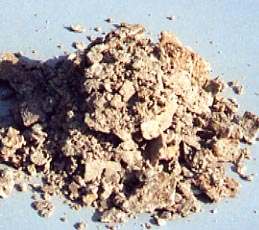
hard water is heated, the minerals dissolved in it
that make it "hard," settle out as sediment
and fall into the bottom of a water heater. The sediment
can build up enough to burn out lower elements on
electrics and overheat the tank bottom on gas models.
The
longer-warranty Richmond water heaters sold by Sutherlands
come with a "self-cleaning" dip tube. The
dip tube is a plastic tube that carries incoming cold
water to the bottom of the tank to be heated and keeps
it from mixing with already-heated water, which rises.
The tube is engineered to keep the sediment from settling,
thus forcing it to flow out of the tank as hot water
is used.
However,
copious usage is required for this to work well. If
you use low-flow showerheads, or have unusually hard
water, or you're buying a six-year-warranty tank,
you might consider a flush
kit from www.waterheaterrescue.com to expel sediment
buildup.
|
 |
Cutting
the wait for hot water
If
your water heater is at one end of your house and
your shower at the other, frustration will be the
result. That's because the water lying in the piping
in between will cool off and it will take you what
seems like forever to run the shower long enough to
get new hot water through the pipes from the tank.
One
solution to this is a recirculation system, either
gravity-feed, or operated by a pump. Such a system
keeps water circulating through the piping and returning
to the tank so that when you turn the tap, there's
no wait. Such a system cuts your water bill because
you don't have to run so much down the drain to get
the hot water flowing. But it will probably increase
your energy bill, even if you insulate the pipes,
because the heater will run more to keep the water
hot. It can also be messy to retrofit a house with
a recirculation system.
An
alternative is a Metlund
device. At the touch of a button a minute before you
need hot water, it pumps cold water from the hot line
back into the cold line and back to the water heater,
thus drawing hot water from the heater without running
the cold water down the drain. It's simpler to install
than a recirculation system and heat loss is limited
to the water that cools off in the pipes after each
use. The Chilipepper
appliance works in a similar way.
|

|
|
Explosion
control
Nearly
all water heaters are equipped with a safety device
called a temperature/pressure relief valve. Its purpose
is to open and vent water and pressure if temperature
or pressure exceeds the valve's limit. Water heaters
rarely explode, but when they do, it's much like a
rocket launch. It's catastrophic, in fact.
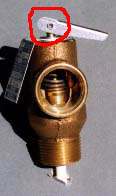
T&Ps,
as they're called in the trade, should be tested once
a year by pulling up on the silver handle. Water should
flow freely and stop when you let go of the handle.
If it does nothing, or dribbles or drips, then it
should be replaced. However, if one of those latter
two possibilities occurs. banging down on the spindle
of the handle will sometimes help the valve reseat
and stop dripping/dribbling. People seldom test their
T&Ps, but this is a $6 part that can save your
house or maybe even your life. They are especially
prone to gunk up with calcium in hard-water areas.
Test your T&P!
Return
to top |
Do-it-yourself,
or maybe not
We
at Sutherlands pioneered the concept of do-it-yourself
in the United States, saving our customers truckloads
of money in the process. Installing a water heater
isn't that difficult, but there are enough dangers
involved that we think that often people will do better
to leave it to a professional, who not only knows
all the codes, but knows the reasons they are
codes. In particular, 220-volt appliances can be quite
dangerous. We want our customers to be with us for
a long time to come.
|
Smelly
water
In
some parts of the United States, there are anaerobic
bacteria in the water -- often in wells -- that will
react with normal anode rods to create hydrogen sulfide
gas. You open the hot tap, you get rotten egg odors.
Sometimes it also discolors laundry. The quick fix
for a typical 40-gallon tank is to open it and pour
a couple of pints of hydrogen peroxide into the water.
Chlorine bleach will also work, but peroxide is a
lot safer. Then open the taps to get the treated water
into the piping and kill the bacteria there.
The
long-term fix involves removing the anode(s) that
came with the tank and replacing it with a special
aluminum/zinc anode. Those are available at www.waterheaterrescue.com,
which also contains considerable information about
all aspects of water heaters and offers troubleshooting/problem-solving.
|
Clattering
noises
If
you can hear an annoying rattling sound, especially
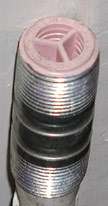
at night, suspect what are known as heat-trap nipples.
These were designed to help water heaters meet federal
energy conservation requirements. They consist of
a nipple, which is a connector threaded at both ends,
the plastic insert you can see at right, and a marble,
which is inside.
The
heat trap keeps heat from rising when the water heater
is not in use. But it also is prone to rattle, especially
if the water heater is equipped with a recirculation
system that keeps water moving. And the piping will
broadcast the noise all over the house. To solve the
problem, simply take a pair of needle-nose pliers,
firmly grasp the top part of the insert, work it loose,
and throw away the marble.
|
|
 |
Water
heaters in apartments
If
you are a landlord and are reading this, consider
paying a visit to the commercial
section of www.waterheaterrescue.com.
It will tell you how to get the most from new water
heaters and save money and grief in the process. We'll
be happy to source the water-heater end of the equation
for you and Water Heater Rescue will provide
the rest.
The
Tank, a water heater forum
In
September, Water
Heater Rescue started a bulletin board
and forum called The
Tank, where people can go to get answers to problems
and discuss issues. Its purpose is to promote exchange
of knowledge and understanding among plumbers, builders,
architects, apartment people and the public. So if
you have a problem that you don't see here, considering
looking at the site's troubleshooting sections or
using The
Tank.
|
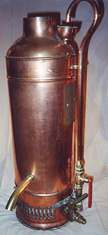
Water
heating from 100 years ago
They
don't make 'em like they used to, which is too bad.
There were many innovations from that period that
are no longer in use today. Some designs were even
superior, but because they cost more, they were relegated
to the scrap heap of history. And undoubtedly, water
heaters were vastly more ornate and beautiful, such
as this Ewart Royal Geyser bath heater, than today's
plain-looking steel cylinders. For a peek at water
heating from a time when the idea of daily bathing
was just becoming popular, visit the Weingarten
Collection.
|
 |
|
|
| Randy
Schuyler operates www.waterheaterrescue.com,
which is dedicated to making sure water heaters function
safely, efficiently and for as long as possible. He
has known the Sutherland Family for many years. |
|
Please
read our Terms of Use regarding outside
links.
|